The call that never quite ends
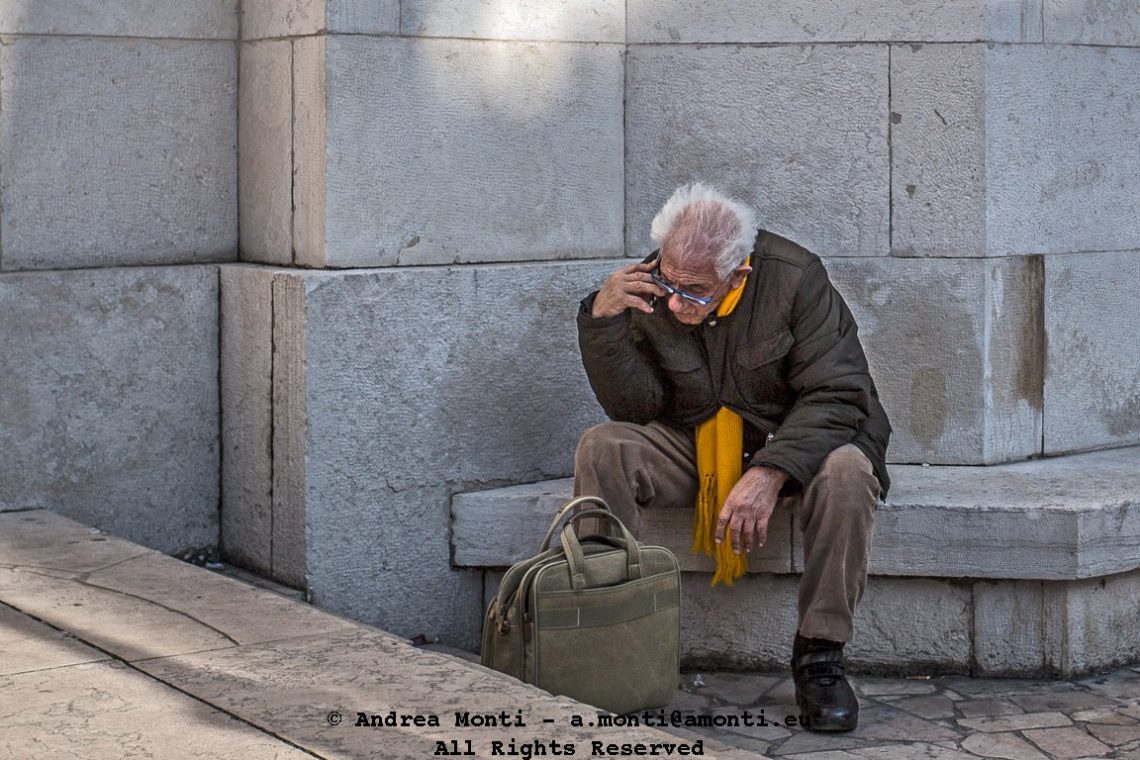
Street photographs often succeed by what they withhold. Here, the frame is built from reticence: a lone older man sits on a low stone ledge, pressed into the corner where two monumental walls meet. The architecture dominates—big blocks, hard seams, an impersonal geometry—while the figure occupies a comparatively small portion of the image, almost as if the city has filed him into the margin.
That imbalance is the picture’s first statement. The setting is an active force. The masonry reads as civic, official, enduring. Its scale and texture suggest permanence, while the man’s posture—forward-leaning, shoulders rounded—suggests the opposite: the temporary, the contingent, the vulnerable. This photography trades in such contrasts, cleanly, without theatricality.
The focal detail is a gesture near the face: a hand lifted as though holding a phone. The bowed head turns the action inward. It is not a buoyant call, The expression is partially occluded by angle and glasses, yet the body supplies the narrative: this is waiting, this is listening, this is endurance.
Colour, used sparingly, becomes a second voice. Most of the frame lives in a restrained palette—stone greys, muted browns, the dull green of outerwear and bag—until the yellow scarf interrupts like a flare. That scarf is is compositional punctuation. It pulls the eye to the centre of human presence and signals warmth against cold surfaces. It also functions symbolically: something personal, chosen, soft, set against a world of engineered hardness.
Then there is the bag, placed on the ground in the foreground, slightly forward of the man’s knees. In street work, bags are often accidental props; here it behaves like evidence. Its position suggests a journey, a delivery, or the administrative logistics of a day lived on foot. It tells us the man has come from somewhere and will go somewhere else, even if the photograph captures him at the precise point where movement has stalled. The bag also sets a quiet boundary: it occupies space in front of him, a modest perimeter of possession in an open public place. It is a practical detail, but it becomes a narrative one.
As a piece of photojournalistic storytelling, the image offers a recognisable subject—urban solitude—without leaning on cliché. The man is not sensationalised. He is allowed dignity through distance and through the refusal to pry. The picture keeps the subject’s privacy intact while still offering a readable emotional register, which is an ethical balance street photographers do not always achieve.