My camera’s early test shots
Unlike fishing villages or marinas, they are not built to be looked at. They are built to work. Every object has a purpose, every line leads somewhere, every apparently random piece of machinery exists because somebody, at some point, needed it to solve a practical problem. There is very little room for decoration.
This is probably why I enjoy photographing them.
The first temptation, when arriving at a place like this, is to reach for the widest lens available and try to capture the “beauty” of the harbour as a whole. There is certainly nothing wrong with that approach. It produces pleasant landscape photographs, usually with colourful boats, dramatic skies and a picturesque sunset if one is lucky enough.
The problem is that this kind of image rarely says anything about the harbour itself. Instead, what interests me is the relationship between function and form.
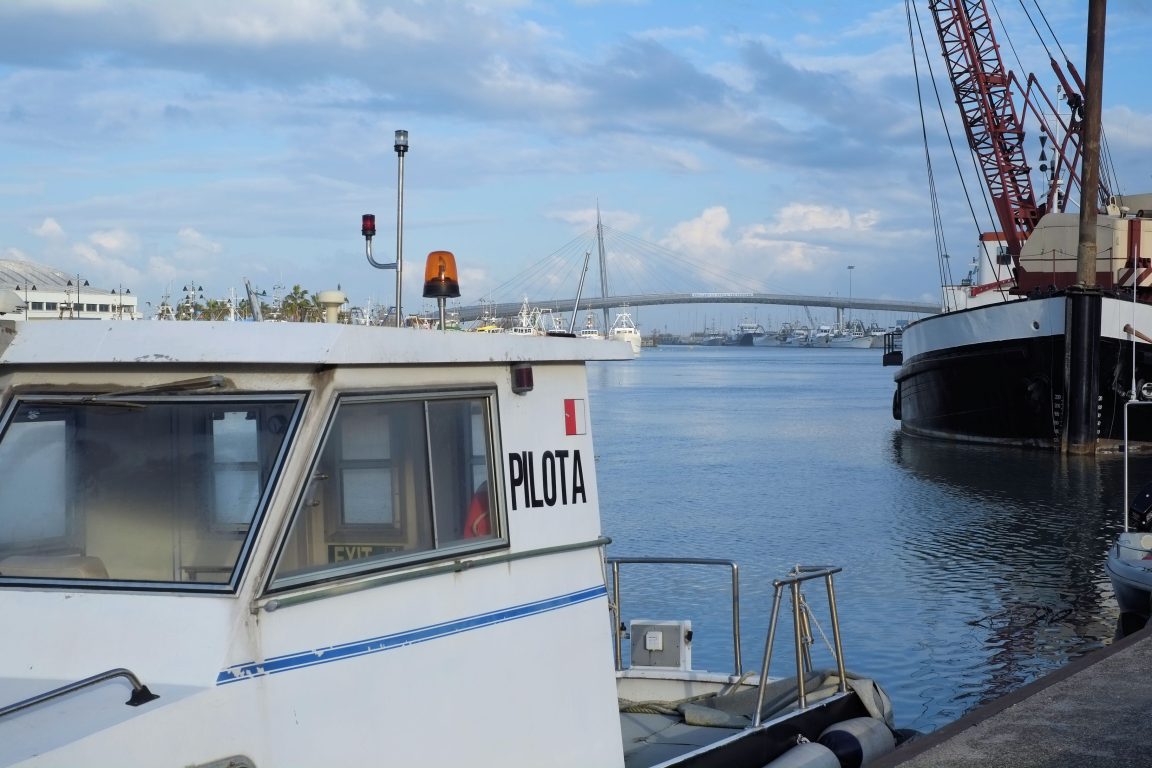
Take the first photograph.
The eye is naturally drawn towards the elegant cable-stayed bridge in the distance. It is an impressive engineering work and, compositionally, it could easily become the main subject. Yet it is not. The real protagonist is the small pilot boat occupying almost half of the frame.
At first glance this may appear unbalanced. Why allow such a large white mass to dominate the foreground? Because that is precisely how working harbours function. Large infrastructures exist to support apparently ordinary activities. The bridge is spectacular, but the pilot boat is what actually keeps ships moving safely in and out of port. The hierarchy of the photograph reflects the hierarchy of the harbour rather than the hierarchy of visual attractiveness.
Even the crane entering from the right-hand side performs the same function. It does not complete the composition in the traditional sense. Instead, it confines it. The image becomes a corridor of industrial activity whose destination happens to be the bridge.
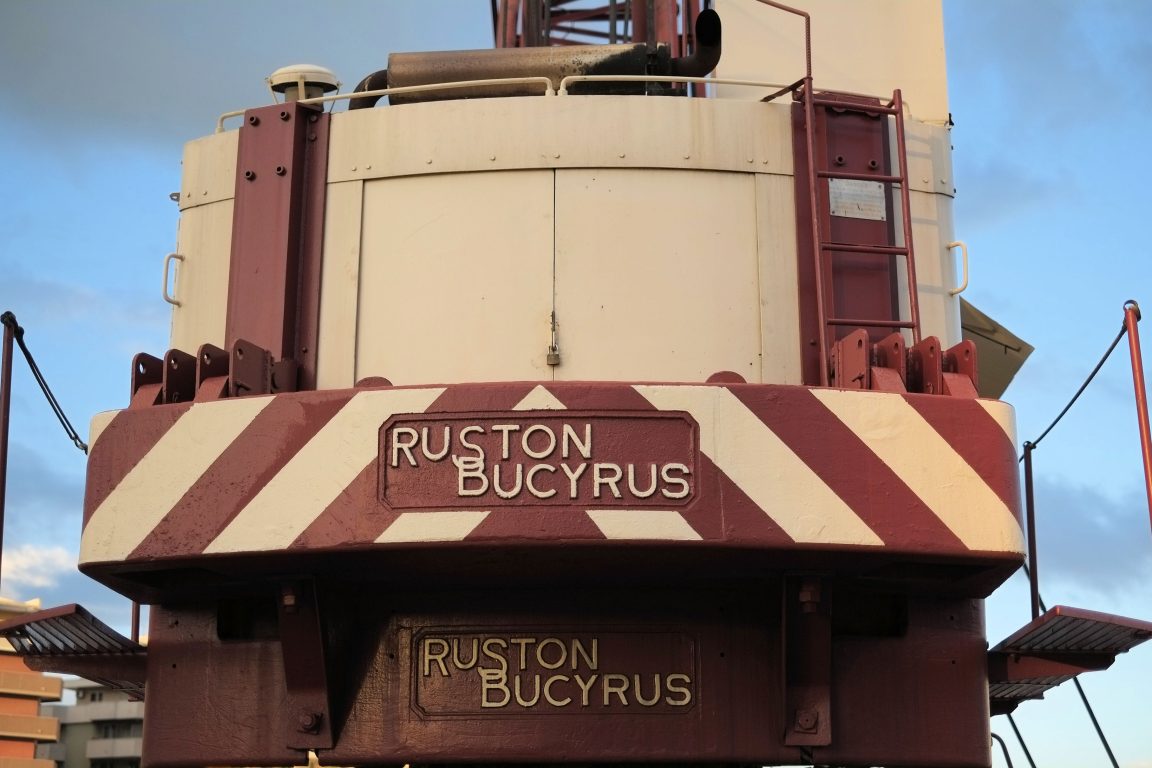
The second image pushes this reasoning further.
Nothing “happens”. There are no workers, no movement, no spectacular action. Only the upper structure of an old Ruston Bucyrus crane fills the frame almost symmetrically.
Ordinarily, photographers are advised to avoid frontal views because they flatten perspective. Here, flattening becomes the point. Industrial machines often possess an unexpected dignity when photographed without dramatic angles or visual tricks. Looking straight at the crane removes the illusion of movement and turns it into something closer to architecture than machinery.
The repeated Ruston Bucyrus markings reinforce this perception.
There is also another aspect that interested me. Old industrial equipment carries its own typography. Manufacturers once considered their logos as permanent elements of the machine rather than disposable stickers. Decades later, those embossed letters become part of the object’s identity. Photographing them is, in some respects, documenting industrial archaeology.
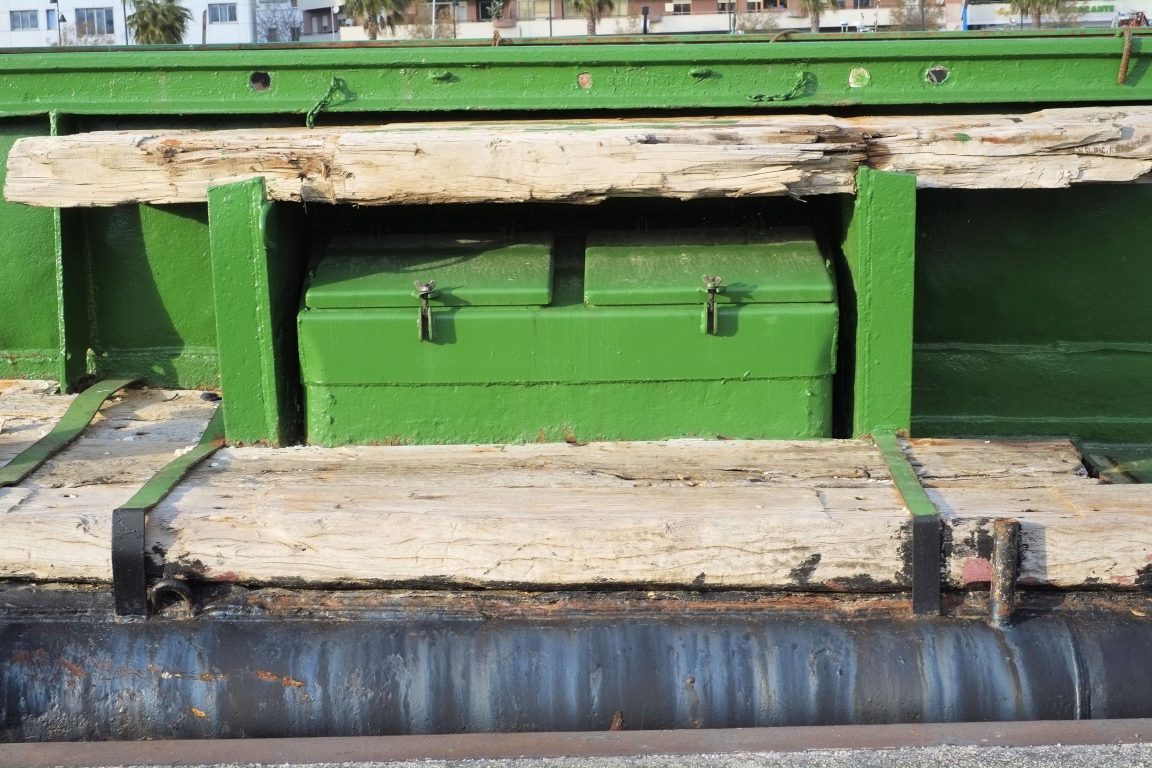
Finally, there is the third image.
Were it not for the green toolbox, one could almost mistake it for an abstract composition. The photograph is built almost entirely on materials: weathered timber, fresh paint, oxidised steel, the black cylindrical fender… Nothing in the frame attempts to describe the boat as a whole. Instead, the image isolates those details that reveal years of maintenance and repair. Every scratch, every replaced plank, every brushstroke of paint tells the same story: this is a working object, not a collector’s piece.
The toolbox becomes the only element suggesting human presence. Nobody appears in the photograph, yet somebody must have placed it there. Somebody repairs this vessel, paints it, replaces damaged wood, tightens bolts and eventually closes that toolbox before going home. The person remains invisible, his work does not. This, perhaps, is what I increasingly look for when photographing industrial environments.
Machines are rarely interesting because they are machines. They become interesting when they silently reveal the people who designed them, used them and kept them alive.
Showing the workers is one way of telling that story. Showing the traces they leave behind is another. I increasingly suspect that the latter says rather more.