Labour Spilling Into Transit Time
The underground systems in Tokyo, where this photo was taken during rush hours, offer countless opportunities to take interesting photos. It’s no surprise that coaches and platforms are an irresistible temptation especially for foreign photographers.
Like every other first-time visitor, years ago I indulged in taking a few pictures in this environment, which, as often happens with photos taken by non-locals, were pretty similar in concept and composition to countless others. This is why I slowed down and tried to make sense of a photo before taking it (not only in Japanese underground). Sometimes, indeed, impromptu shooting works, but you have to be in a state of grace to actually get something worthwhile. That doesn’t happen too often for mere mortals like us (unless you spray-and-pray, but this is camera-toting, not photography), so while we wait for photographic enlightenment, it makes sense to rely on training and rationality.
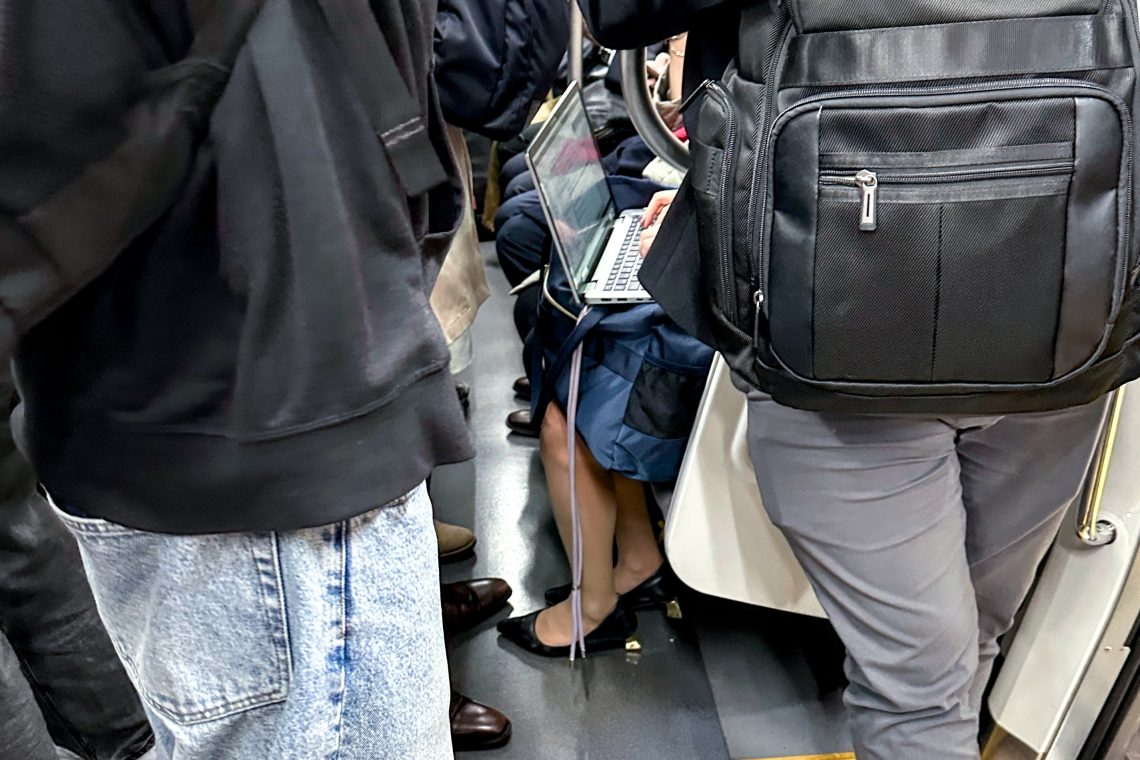
To make a long story short: the underground, in Tokyo, is not just a way of getting between point A and point B, but a place where people spend more time than they should. So, in the crowded space of rush hours, many individual lives unfold, unfazed by the surrouding environment. Some people are unable to stop scrolling through their mobile phones, while others use the reflection in windows as a mirror to check their appearance. Others, like the person in this photo, use their commute (and their luck in finding an empty seat) to catch up on work, so — maybe— they won’t be blamed by their office or a client or just make effective use of otherwise wasted time.
I was impressed by her ability to remain calm and focused in such a distracting situation. Actually, nothing in the image suggests this state of mind, but the assumption that she is was able to work unaffected by the environment was what made my take the shot: once again, the eye sees what the mind wants to see.
Be that as it may, her task was certainly made easier by the silence that usually reigns in confined spaces as, apart from myself, there were no other うる星やつら, noisy Western tourists in the vicinity. While many travellers I have met are educated and respectful, too many forget to look around them before engaging in loud conversations or live-streaming on social networking sites. If nobody around you is behaving like that, maybe there’s a reason why. With a little experience, you can read the discomfort caused by this lack of etiquette in other people’s micro-signals, such as changes in body posture, turning their heads away or moving to another seat.
The latter is not intended as a polemic remark or a stereotype about foreigners — myself included — but is simply an observation based on experience. Strictly speaking, it has nothing ado with the photography in itself, but I think it is useful to provide the subjective context I had in mind when I ‘saw’ the image before taking it.
So, this photo may be of interest for a few technical reasons: the azure blot is used as a focal point to attract the eye of the viewer, the vertical and horizontal dark/bright symmetry of the clothes of the people in the foreground is exploited, and the converging lines towards the centre of the image, suggested by where the bright sections of the people in the foreground touch the dark sections, are implied.
However, as said, I did not take this shot to practice composition, as I was more interested in the message this photo is supposed to convey: a choreography of bodies and things that produces micro-hierarchies of comfort and constraint and a visual anonymisation made of faceless, truncated bodies.
A sense of duty and social isolation, as life goes by, unheeding.