Inside the Nazario Sauro
An important piece of history of the Italian Navy, at the anchor in the Port of Genova.
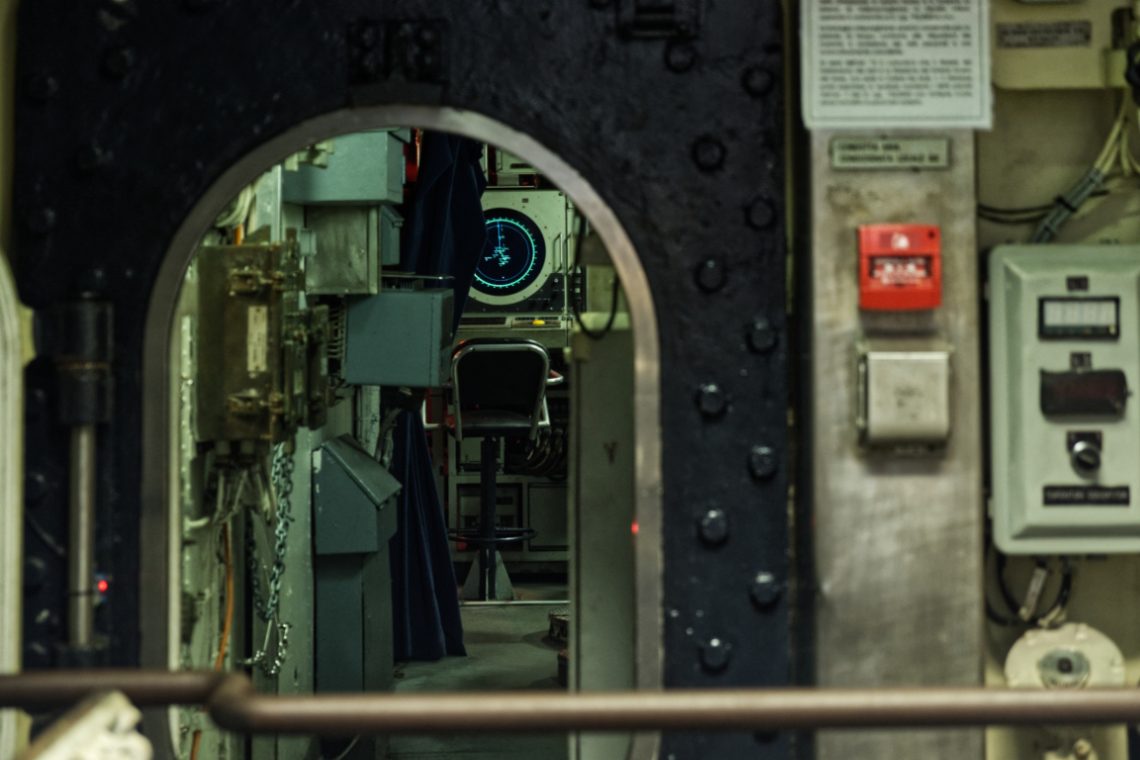
The photograph captures the interior of the Nazario Sauro, framed through the rounded steel doorway of a watertight bulkhead. The structure itself becomes a compositional device: the thick metal, studded with bolts, encloses the scene like a portal, immediately conveying the confined and engineered nature of a submarine’s environment. The doorway narrows the viewer’s field of vision, directing the gaze toward the illuminated radar screen glowing at the far end of the passage.
The corridor beyond is dense with instrumentation. Electrical panels, conduits, and control boxes line the walls, forming an intricate network of hardware that reflects the operational complexity of the vessel. The muted palette—dominated by industrial greens and greys—contributes to the sense of functional austerity. In this context, the soft blue-green of the radar stands out as the only clearly luminous element, adding both visual and narrative focus.
A metal chair positioned before the radar console introduces a human scale, even in the absence of any crew member. Its presence suggests duty cycles, long hours, and the constant vigilance required in submarine operations. The chair’s modest design contrasts with the layered technical environment surrounding it, underscoring the blend of human endurance and mechanical precision characteristic of life on board.
The lighting is low, with shadows deepening the recesses of the passage. This subdued illumination is typical of operational vessels where practicality governs design choices. It creates an atmosphere that is neither dramatic nor decorative; rather, it feels authentically utilitarian. The areas of reflected light on pipes and panel edges reveal the tightness of the space and the dense arrangement of machinery.