David Hume Was Right On Causation… or Maybe Not
One of the core tenets of David Hume’s philosophy is the idea that causation does not exist. What we call ‘causation’ is, in fact, the result of an empirical correlation to which we ascribe ‘deterministic’ significance.
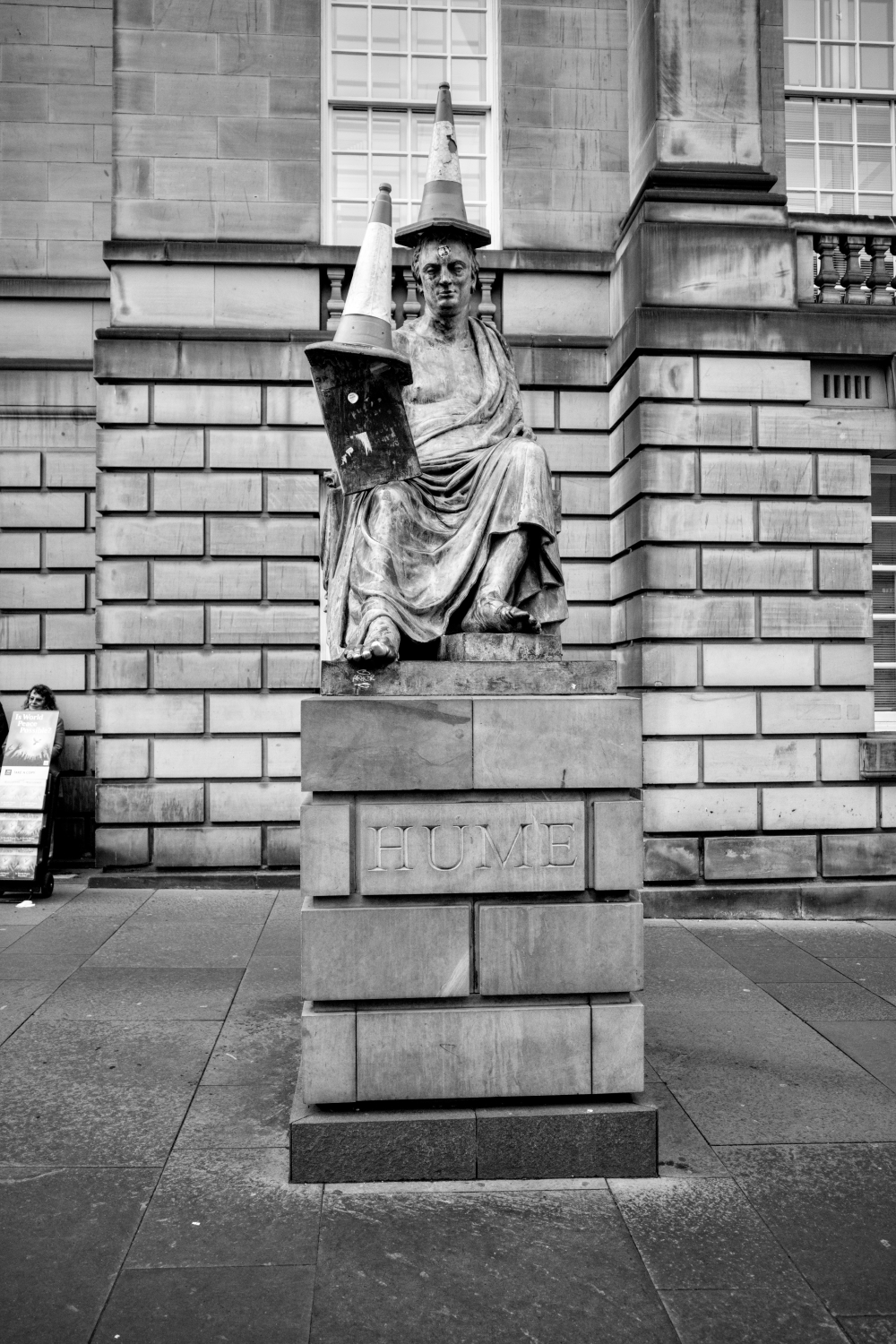
This Hume’s stance has had a huge impact on philosophy, and this photo of the statue portraying him as a Greek philosoper and placed in Edinburgh’s Royal Mile proves him right beyond any reasonable doubt as demonstrated by the widely practiced prank of placing a traffic cone on the statue’s head.
The way to look at it, I was told, is as an innocent, irreverent joke — a display of Scottish humour and defiance against pomposity. However, I read this from a slightly different angle.
It is out of question that, yes, mocking power and ‘symbols’ is a way to maintain a healthy democracy and freedom. I d0n’t challenge either the idea that, yes, nobody should take themselves so seriously that they can’t accept a joke. And, finally, I am aware that, yes, satire is effective only if it stings or scorches. My point, and this is where Hume’s philosophy comes into play, is that what proves him right is that the traffic cone prank, like many effective displays of wit, did not arise from a rational, deterministic process, but from passion overriding reason.
I am not sure that this argument is actually a valid one. It may simply be an overreading of a much simpler fact in order to justify sharing an otherwise trivial photo, similar (or identical) versions of which are widely available on the internet. Nevertheless, this was the chain of thoughts that the pranked statue elicited: ironically, a rational, deterministic, causality-connected argument to prove its opposite.