Ceci N’Est Pas Une Junior (or, Cognitive Dissonance – Part Two)
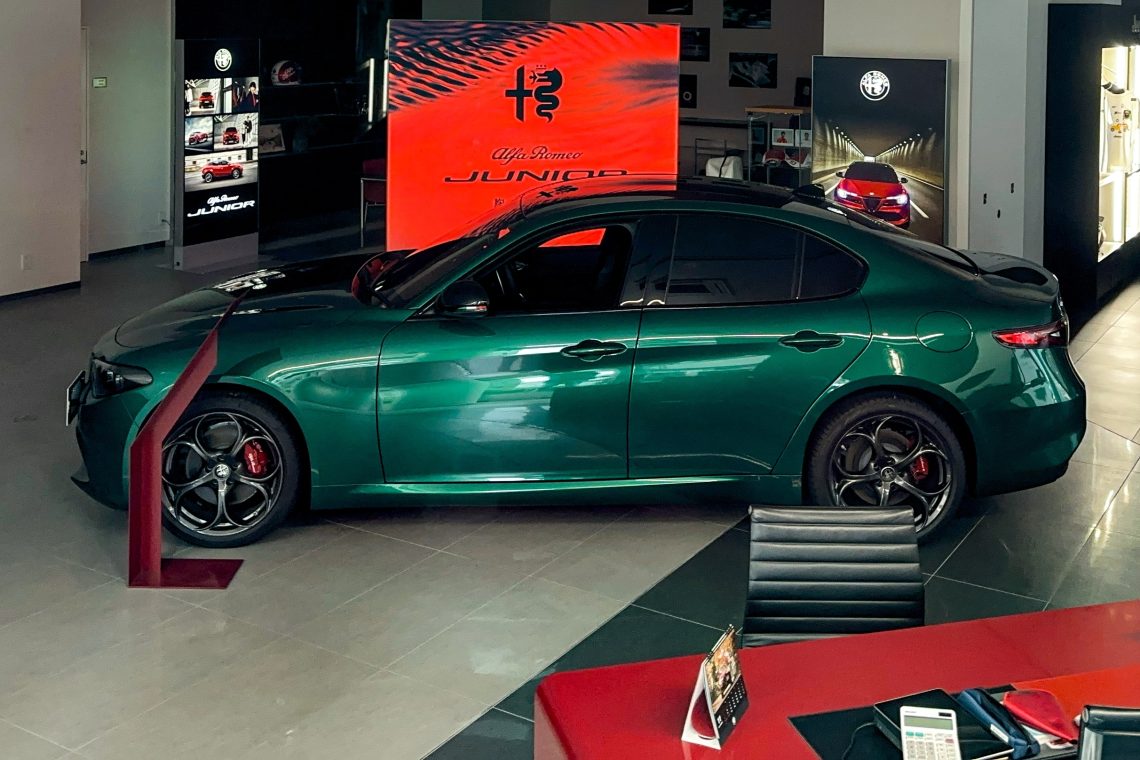
I took this photo last November while exploring a less touristy area of Tokyo: Ikebukuro.
I went there hoping to see a limited edition Alfa Romeo Giulia Quadrifoglio, which was supposed to be on display at an official Alfa Romeo dealership. Unfortunately, the Quadrifoglio wasn’t there and the dealer was closed, too. So, the only option left to save the day was to take pictures of whatever could be seen through the windows. Peeping inside, though, I didn’t expect to find anything interesting in a car dealership, but I was wrong.
As with the photo I took of the Swiss Air fuselage on display at La Rinascente in Rome, also the Japanese one looked somewhat unusual. And also in this case it took me a few seconds to understand where the problem lay: the car is clearly a Giulia, whereas the displays advertise the Junior — a car that shares only the logo with the true Alfa Romeo, because of the result of dismantling the Alfa Romeo sport identity — a concept that, by contrast, was at the heart of late CEO Sergio Marchionne’s strategy.
But I digress, or maybe not, because no salesperson from the hardcore Alfa Romeo community would have treated a car — not only a flagship model — like that. Perhaps I’m reading too much into this photo, blinded as I am by my loyalty to the brand’s history and the models I have owned over the years, including the one I currently drive. Nevertheless, I cannot accept the downgrading of such a car to a ‘global platform’, which is why I find the carelessness in displaying a car alongside banners advertising a different model so disturbing. Moreover, the fact that this photo was taken in Japan intensifies the cognitive dissonance. It was strange to see such a lack of care in a place where attention to detail and coherence are valued.
This long rant finally explains why I took this photo — to document yet another example of cognitive dissonance. As with the Swiss Air fuselage photo, it is possible that the mismatch between the Giulia on display and the Junior on the screens was also deliberate. However, in both cases I don’t think so.
Indeed, this may seem like a minor issue to an ordinary person visiting the shop, but a premium prospect, an existing customer or an aficionado may interpret it as a sign of betrayal. Juxtaposing the Giulia with the Junior implies an inversion of the hierarchy and challenges customers’ commitment to acting as custodians and ambassadors of the brand’s identity. People who are passionate about or own high-end cars do not need a dealer to misidentify a Giulia as a Junior in order to feel insulted. They are, instead, struck by the lack of curation and proper narrative framing, and a lack of respect for the flagship model. The outcome would have been entirely different if the communication strategy had aimed to create a bridge between the Giulia and the Junior, for instance. This would have transformed apparent indifference to premium cues into support for a brand new model targeting a different market niche.
This story also teaches another lesson: what are the odds of a brand-loyal customer from the other side of the world coming to a non-touristy area of Tokyo and noticing all that? Actually, close to nil, but close to nil is not enough because it happened.
As the late Giancarlo Livraghi, one of the most influential copywriters in the advertising industry, taught me, this is what you should look for when trying to generate interest in a product. If someone spots a flaw that nobody else had noticed, your entire campaign will fail because the flaw will stand out like a black spot on a white shirt, and everyone (including your competitors) will focus on it.