Carl Zeiss Ultron 50/1,8 and Pentax K1 – An Empirical Field Test
Across this set, the Ultron performs as expected: good microcontrast and local separation, reasonably crisp edge definition where focus is placed, and a generally “clean” drawing that still keeps tonal roundness in mid-tones.
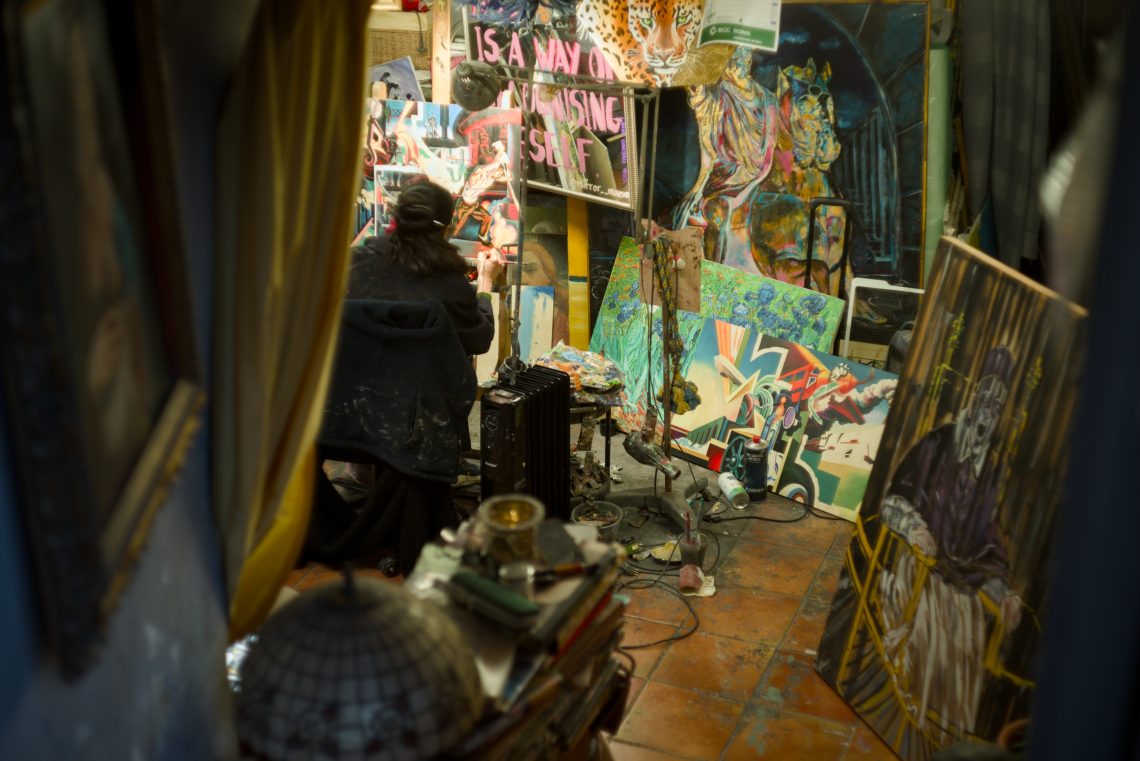
Of all the photos in the set, that of a studio interior in via Francesco Crispi, Rome used as the featured image is the most portrait-like. It simultaneously showcases layered clutter, selective focus and a complex colour palette. The transition from sharp to soft is smooth, and the blur looks natural. The microcontrast in the focus plane shows the Zeiss ‘bite’ without looking artificial.
At dusk, the scaffold corridor is a test of distortion, contrast and flare. Post-production allowed the geometry to be managed and the details recovered so that areas in marginal light do not appear veiled or grey.

This photo of the side entrance to Rome Nobu is dominated by warm lighting and specular reflections. The flare resistance and tonal separation are both fairly good.

This was an easier shot. It was taken in the morning with no harsh light and a clear separation between the subject in the foreground and the background. Actually, there is nothing to complain about, as the lens behave decently.

This half-spherical structure was located near the beach playground seen in the previous photo. It demonstrates Ultron’s ability to create good background/foreground separation and deliver its signature 3D pop effect.

The K1 II seems to be a good match for the Ultron. Perhaps — but I don’t have any concrete evidence to support this — the lens wouldn’t perform as well on higher-resolution cameras. However, it seems that the its performance is not affected by the K1’s 36 megapixels.
Of course, but this isn’t unique to the Ultron, shooting manually with fast lenses wide open is always challenging. Thus, since the laws of optics cannot be changed, it is up to the photographer’s skill to get the shot right. Thus, since the laws of optics cannot be changed, it is up to the photographer’s skill to get the shot right. So, it worth reiterating the point, the blur affecting the dark images was probably caused by the combination of shooting wide-open and the micromovements caused by keeping the ISOs as low as possible, a choiche which pushed the K1 IBIS to its limits.