Lunch hour geometry
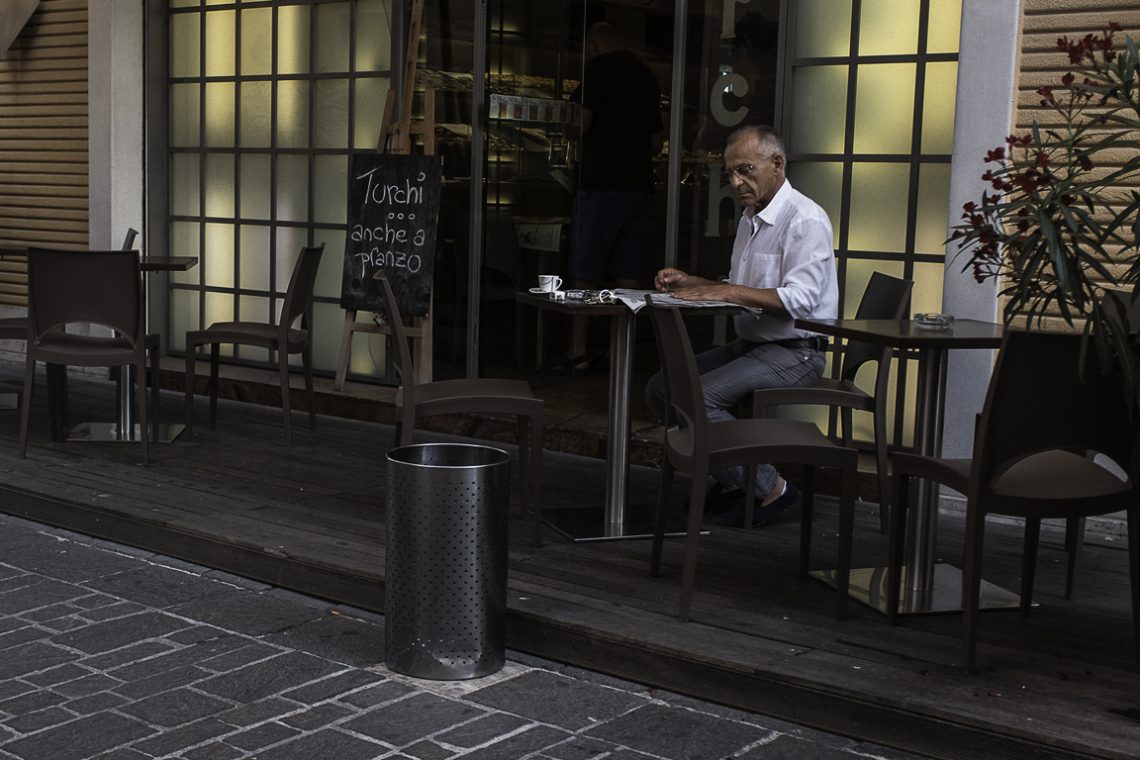
Urban life often reveals itself not through grand gestures but through quiet repetitions. This photograph was taken during an ordinary lunch hour, in front of a small café where the boundary between private routine and public space becomes almost imperceptible.
An elderly man sits alone at a table, absorbed in the slow ritual of reading while his coffee cools beside him. His posture suggests familiarity rather than urgency. This is not a hurried pause between commitments but a measured suspension of time, shaped by habit and personal rhythm. Around him, empty chairs and unused tables form a subtle choreography of absence, reinforcing the sense that this moment belongs more to reflection than to social exchange.
The visual structure of the frame is governed by a restrained geometry. The grid of the backlit panels behind the glass doors creates a luminous backdrop that contrasts with the darker wooden platform and the textured stone pavement in the foreground. Between these two spatial layers, the cylindrical bin becomes an unexpected anchor — an almost sculptural element that stabilises the composition while quietly dividing the scene into separate zones of activity and stillness.
Light plays a decisive role. The soft interior glow filtering through the panels lends the setting a muted theatrical quality, as if the café itself were a stage where everyday gestures unfold with understated dignity. The tonal palette remains deliberately controlled, allowing the viewer’s attention to settle on the relationship between space, solitude, and routine rather than on any single dramatic detail.
Photographs like this rarely impose a narrative. Instead, they suggest one. They invite the observer to recognise familiar patterns — the solitary lunch, the habitual reading, the unnoticed architecture of urban pauses — and to consider how public places quietly accommodate private lives. In this sense, the image belongs to a documentary tradition that values duration over action and atmosphere over spectacle.